Bitcoin Memes (Cuz I Dont Wanna Write Today (12/15/2020))

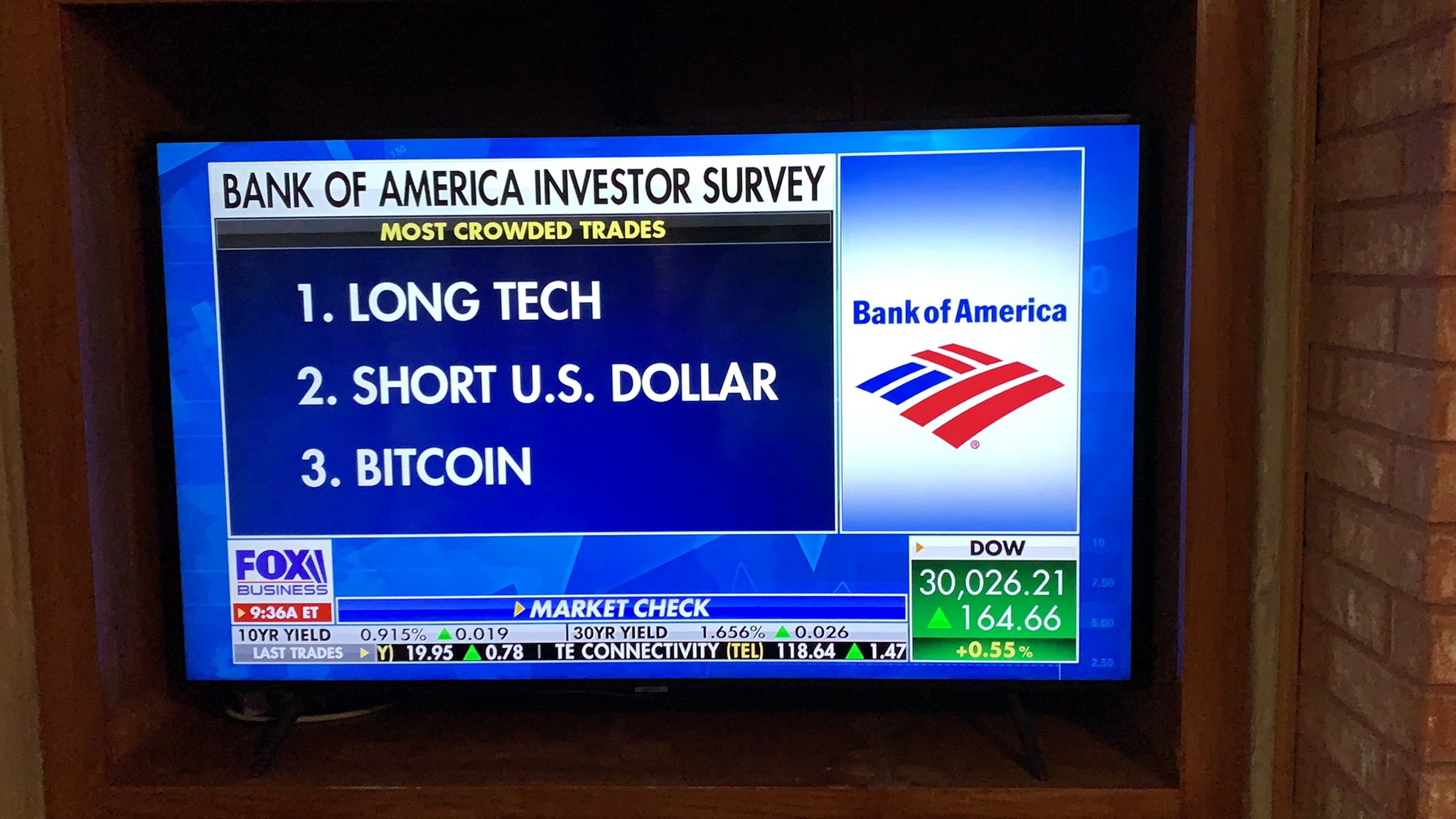
Image
Thank you @BlockFi for this gem
Image
Thank you @SalsaTeklia for this masterpiece.
Image
Not a meme… but not, not a meme @GaryLeland
Yesterdays Bitcoin Interactions Today:
  • “Bitcoin may be getting ready to crash” -Random neighbor who doesn’t own Bitcoin but likes to send me texts like this whenever he watches the news.
  • “You should cash out now. Bitcoin is going to nothing” -My friend who is a psych major
  • “It’s just too difficult to understand” -My other friend who has a 4.0 at Duke as a chemistry major

Yesterday was a frustrating day.

BTC Price:

Somewhere around $19.4k. I think we will see 20k this week.

-Kram

BTC, Finance and Sonnets(12/14/2020)

The internet was created in 1974 by Vinton Cerf and Robert Kohn when they produced the Transmission Control Protocol/Internet Protocol (TCP/IP). This invention allowed data to be broken down and transmitted over long distances to the right destination.

It was roughly 20 years before the Internet became the Internet. Ya know, the place where we waste time looking at memes, save time by letting robots do our taxes, and yell at each other in all capital letters about our political views. Yeah, that place.

Ever since the Dot Com crash in 2001, the internet has normalized and we have entered the Digital Age. What started with email, transformed to social media, twisted into shopping, replaced traditional entertainment, and made a small world even smaller.

Amazon moved shopping online.

Netflix moved entertainment online.

Google moved information online.

Facebook moved friendship online.

Apple moved communication online.

The Digital Age has seen a shopping, entertainment, information, friendship, and communication revolution IN ONLY 20 YEARS.

You know what hasn’t seen a radical transformation in the last 20 years?

Money. Sure, we can pay for things online, use Venmo or Cashapp to ‘instantly’ send money to friends, take pictures of our checks to deposit them, and all that cool stuff.

However, the entire concept of money has remained relatively unchanged. Banks have taken the Digital Age and slapped band-aids over their existing infrastructure. Credit cards still take days to finalize, sending money overseas is a rhymed wrapped in a riddle, and credit scores are still based on your credit history (which is hilarious because, um, how can you have credit history if no one will give you a credit card because you don’t have credit history?).

It’s pretty crazy, how slow money moves in the context of the Internet.

It’s pretty crazy, that the internet still runs on dollars, those green paper things with dead white dudes printed on them.

It’s pretty crazy, that people think Bitcoin is going to fail because it is the first successful attempt to move money online.

Bitcoin is the first natively digital currency.

Bitcoin is also the most secure digital currency.

Bitcoin is the first step in the Digital Age’s financial revolution.

Crypto News Sonnet:

MassMutual bought $100 million in BTC

The narrative of reserve asset solidified

Just ask the guys over at Microstrategy,

Buying $650 million in BTC… Citibank is terrified.

Grayscale is still doing their thing

Buying BTC and ETH, a sidedoor ETF

Making all the cyberhornets sing

Though it still seems that Peter Schiff is deaf.

Pomp is Podcasting and Peter is asking What Bitcoin Did

Listen to Ryan Selkis, Lynn Alden, Cynthia Lummis, and Gary Vee,

If you want to stay up to date and on the crypto grid,

It’s a good place to start for newbies, especially.

The world of crypto is moving fast

Buy some BTC and to the moon you shall blast!!

BTC Price: $19,123.78

-Kram

Bitcoin, What is it? (12/13/2020)

This has been a pretty magical week for the worlds first digitally native money. MassMutual purchased $100 million worth of Bitcoin as a reserve asset. Microstrategy popped off for another $650 million of Bitcoin using something called a “conventional bond sale.” Canada saw its’ first Ethereum ETF go live on their stock market. The price has held steady at around 18.5k, with a few late night forays into 17k and 19k. It is a great time to be a hodler.

I thought today would be a good time to talk about Bitcoin and the pesky “question” :

What is Bitcoin?

Magical gold that fits into your pocket and can be teleported across the world in mere minutes for a negligible fee. 

What is Bitcoin?

It’s money. It can be used as a store of value, unit of account, and a medium of exchange. Although it’s not very good at doing any of those things… YET

What is Bitcoin?

A decentralized network of computers working together in order to constantly secure the data it creates. 

What is Bitcoin?

Software that took the characteristics of money and transformed it into bits and bytes.

What is Bitcoin?

A safe haven from central banks constantly printing money and degrading the dollar/yen/euro/etc.

What is Bitcoin?

Simple, it’s a Peer-to-Peer Electronic Cash System.  

What is Bitcoin? 

Libertarian ideology baked into cutting edge technology being served to the masses as a financial tool. 

What is Bitcoin?

The United States calls it a commodity. Fidelity calls it an alternative asset. Paypal calls it an offering. Square calls it a reserve asset. Many people in Venezuela call it a life (savings) saver. 

What is Bitcoin?

The first and most secure blockchain network. 

What is Bitcoin?

The Future. 

The hardest thing about understanding Bitcoin is the most simple question: What is Bitcoin?

I’ve read five or six books on the subject. I’ve taken a blockchain course at an established University. I stay up to date on Bitcoin Twitter, the most wonderful corner of the universe. I listen to “The Pomp Podcast” and “What Bitcoin Did” almost daily. I hodl as much coin as I can (it’s not much, sadly). 

Yet, every single time I try to explain Bitcoin to a FIAT friend, I find myself rambling to nowhere. 

“Dude, ok, so like Bitcoin is this network of computers that race to solve this super complicated math problem. Whenever a computer wins the race it is rewarded bitcoins, with a lowercase b, and that is how bitcoin created. We call that bitcoin mining and it is also how the network is secured cuz like the harder the math question is to solve the better the networks security….” 

*friend’s tilts head sideways, mouth slightly agape in absolute confusion*

“Ok ok let me restart. So Bitcoin is basically this piece of code that transformed the properties of money into digital form. You know the three basic principles of money right? No? Well, for money to properly function as money it must be a store of value, unit of account, and medium of exchange. 

~friend’s eyes start to glaze over due to econ 101 ptsd~

“Alright, alright, alright. I can see you’re not listening anymore. Whatever. Bitcoin is the future of money. Simple thought experiment: what will your future kids (insert quick side conversation about how unlikely that either of us will have kids any time soon due to the cosmic ineptitude of 20 year old dudes to understand females) be more likely to buy: a piece of paper with a dead white guy on it, a digital currency, or a bar of gold?” 

@friend thinks for roughly twelve seconds and asks… 

“Why didn’t you just start with that? All that other stuff is way too complicated.” 

Occam’s Razor tells us that the most simple of two explanations is often the answer. I choose to believe that Bitcoin is digital gold. That is not a groundbreaking idea. The first book I ever read about Bitcoin was literally “Digital Gold.”

What is not simple is the underlying technology, ideology, and utilization of Bitcoin because… 

It can be disconcerting to someone not versed in the pseudonymous world of crypto to type into Google: “who invented Bitcoin”, only to find the faint outline of Satoshi Nakamoto haunting the early forums of Bitcoin developers. 

It can be easy to dismiss Bitcoin as fake internet money when it swings 30% in a week… or 300% in a month… or 3000% in a year because something so volatile must be part of a bubble or ponzi scheme or something illegal and sketchy. 

It can be tough to grasp the concept of Bitcoin when someone must first understand the concept of money and the power of inflation in order to realize what makes Bitcoin special. The halvening, “ONLY 21,000,000 EVER CREATED,” the central bank goes “brrrrrrrr,” and everything that makes Bitcoin scarce functions as a direct contradiction to how many central banking platforms act. 

It can be hard to understand the difference between a public key and private key and how to store Bitcoin safely when every article you run into reminds you that “IF YOU LOSE YOUR PRIVATE KEY YOUR BITCOIN IS GONE FOREVER AND NOBODY WILL HELP YOU FIND IT SO GOOD LUCK AND ALSO EXCHANGES SUCK SO DON’T USE THEM EVEN IF THE USER INTERFACE IS SUPER EASY COMPARED TO THE HARDWARE/SOFTWARE WALLET YOU ARE CURRENTLY USING.” 

Bitcoin is scary to the Fiat Friends and Family of us crypto-maniacs. 

It’s confusing and a bit sketchy and wonderfully volatile. 

It’s a deflationary store of value secured by the worlds strongest nest of cyber hornets constantly updating itself in order to evolve into something…. Something the world has never seen before.

And before you go and try to explain it to Fiat Fred or Dollar Don or Gold Gary, bring it back to the basics, to what makes Bitcoin special…

Somehow, some way, we have figured out how to transfer unique bits of value over the internet in a way that cannot be hacked and has the characteristics of money.

In an era of technology and innovation…

What is going to be used by the next generation? 

A physical safe full of gold?

Or a network of digital gold? 

I have my money on the bitcoins. 

-Kram

Bitcoin Manifesto: The Secret Sauce, The Mojo, The Good Stuff (Part 1)

1. There will only ever be 21 million bitcoins created. *woah*

Context time! There are over 46 million millionaires in the United States (according to Google, which is better than according to Facebook but worse than according to the one news outlet you trust because the ~other~ guys are so biased).

You do the math (or pull out your phone and type it in because mental math is soooooo 1983). Ok, ok, I’ll do the math. That means there are not even enough Bitcoins for those stuffy millionaires to each have one. Moral of the story: 21 million Bitcoins is really not that many Bitcoins.

More math! Let’s assume that Bitcoin becomes popular enough that everybody who uses Uber decides to throw some money into Bitcoin. People who Uber seem like the kind of hip, in the know people who would be interested in digital money.

Guess how many people use Uber? The internet says 78 million people. 78 people use a car sharing service that was started less than a year ago and has been surrounded by controversy (shoutout to Lyft… more people should use Lyft).

That means each Uber user would only get (quick mental math) less than a third of a Bitcoin…

Bitcoin. Is. Scarce.

Get your ticket before they run out. Right now you can buy a Bitcoin for 18,000 dollars. That’s with only 25 million owners (type in “how many people own bitcoin?” on Google, don’t trust my silly internet words).

What happens when every Uber user decides to use their hip, in the know-ness to buy a coin? That almost triples the demand! I may not be the smartest cookie in the Tiff’s Treats box, but I did get an A- in Econ 101.

When demand increases, price increases, until supply rises to match demand. (Basic stuff. Look up Supply-Demand curves on Youtube for a refresher if this is giving you Freshman year PTSD.)

If the supply is capped at 21 million… what will make that supply curve move? The price!!! As the demand for Bitcoin rises, the price will keep pushing higher and higher and higher because supply cannot be increased through production.

The only way to convince someone to sell their Bitcoin is to bid higher and higher prices, because there will only ever be a certain amount made.

2. Bitcoin is volatile.

Crazy volatile. Like oh my gosh there is the possibility that I lose all of my money volatile. The price jumps around like a second grader forced into a double dutch jump roping competition in gym class on a particularly rude Tuesday morning. The price can fall unexpectedly, then jump right back up with exuberant resilience, and then find a groove until the next time it gets tripped up (shoutout to Mt. Gox for being a particularly terrible double dutch partner).

This is to be expected. Bitcoin is ten years old. TEN. Guess how old gold is (it’s around 200 million years old according to a sketchy website I found using Bing because sometimes you need to use Bing to remind yourself that grass isn’t always greener on the other side). Bitcoin is a child compared to Gold or money or any other ~money thing~ you are currently thinking about like “ohhh but Bitcoin is so volatile compared to this thing I think is so cool” (cough stock market people).

Here’s how I think of Bitcoin. It is the illegitimate child of the internet and money.

The internet, as we know the internet, has been around since the mid 90s. The internet revolutionized the way we have communicate (email), shop (Amazon), entertain (streaming/Netflix), work (Zoom), and interact (aka we stare at our phones the whole time doing our best to pretend the real world doesn’t exist).

Money has been around since, ummm, forever. It’s part of life. We use it every day and probably don’t even think about what money actually is. Like seriously, why do ten pieces of paper stamped with George Washingtons weird haircut let me purchase ten tacos from Taco Bell? It’s literally a green piece of paper with a dead dude on it.

Well, it’s because (time for Econ 101) we trust that ten dollars is ten dollars is ten dollars. It’s ingrained in society (it’s actually because we trust the United States to keep ten dollars worth ten dollars and that paper bills do a good job as a store of value, medium of exchange, and all those other Econ 101 terms about characteristics of money… but that is just too complicated and hurts the brain).

Bitcoin is the internet version of money! The dollar bill, be it a piece of physical cash or that number sitting in your bank account, Venmo balance, or wherever you keep your money, is a legacy of the old, paper based system of money.

Bitcoin is the cross section between money and technology.

At its core, Bitcoin is exactly that… a piece of code (the bit), housed on the internet, that can be used as a medium of exchange, unit of account, and a store of value (the coin).

The fundamental concept of Bitcoin is easy to understand. It’s a digital form of value. A network of money. The internet of exchange.

The way we use the dollar is outdated. It’s Blockbuster and Bitcoin is Netflix. The Dollar is the U.S Postal Service, Bitcoin is e-mail. The faces of George and Ben and Andrew and all of those dead old fellas found on those green pieces of paper you so love are going to be no match for the digital wave of money that Bitcoin has pioneered.

But…

It’s going to take a long time for that money to find its value. We are living in the VERY beginning of Bitcoin’s existence.

Thought experiment (not based in historical accuracy but also not not based on historical accuracy): what do you think happened when Gold was first introduced as a currency? The first piece of gold was probably bought for like two shells. And then the next week as the utility of gold as money was found to be pretty freaking good, I bet the price of gold skyrocketed to like five shells and a lamb. Or something like that. This is what we call price discovery.

Volatility is to be expected during the phase of price discovery. It should make you excited. There is opportunity here to 5x your shells and lambs. There is also the possibility of losing your shells and lambs (so maybe only invest an amount of shells and lambs that you can lose without going hungry in your hut until you understand Bitcoin enough to sell your hut to buy Bitcoin).

So buckle up. Download some apps to watch the price. Buy the dips and hold the highs.

3. The technology behind Bitcoin is called Blockchain and you should remember that name.

Blockchain is what makes Bitcoin so cool, it’s also what makes Bitcoin so gosh darn confusing. That’s because it’s technical. It uses words like nodes and hash rate and mining and decentralization. Ew.

Here is what you need to know about Blockchain. Blockchain is the way Bitcoin holds your money/value. Blockchain holds together Bitcoin like the internet holds together Facebook/Amazon/Apple/Google/etc. Without the internet bringing information and power from a million different places, those services wouldn’t exist. Same with Bitcoin. Bitcoin would not exist without the Blockchain constantly holding it together.

Sooo, the question is: what is Blockchain?

In broad strokes, the Blockchain is THE journal maintained by hundreds and thousands of computers across the world working together to record each and every Bitcoin transaction.

I hope you read that sentence and thought to yourself: “self, doesn’t that just sound like how the internet works? Also, isn’t that how normal banks do their banking things?”

The answer is yes.

Here is where I will go full info-mercial on you. Queue the “but wait… there’s more” and roll out the boat that I’m going to saw in half and then glue back together using flex seal (if this allusion is lost on you… click this link https://www.youtube.com/watch?v=httSHnNXN10).

The Bitcoin blockchain is ~special~ because nobody is in charge of it! Gasp. Seriously. Nobody is in charge of your money. The blockchain (which is basically a bunch of badass code that has proven sturdy over its’ ten year life span) is in charge of your money.

Bitcoin is decentralized. That is a big word that basically means that instead of trusting say Wells Fargo to hold your money, you are trusting thousands and thousands of computers to run a constant audit of who owns which bitcoins. It’s freaking magical.

Now the question becomes whether you would rather have Kurt from Wells Fargo (Jake from State Farms cousin) handling your money or a nameless set of thousands of computers across the world. Both are weird when you think about it. Both involve a lot of trust.

I mean, I am sure that Kurt is a great dude… but Wells Fargo? How can we be sure they are making correct decision s with our money or how can we be sure that they actually have our money for withdrawal when we go ask for it? When you really sit down to think about it, it is kinda of scary.

That is why I think the blockchain is so cool. It takes the qualitative human characteristic of trust and turns it into a few lines of code. Instead of relying on Kurt from Wells Fargo, you can look at this open ledger of value and the computers on the network (and lets be honest…. Computers are much better at math than us silly homosapiens) to make sure your money safe and in the right place.

Don’t let people scare you away with a scary word like Blockchain. It’s simple. It is a new way to store data, in the case of Bitcoin, to store value. It is an open journal of transactions showing who owns what bitcoins.

4. To understand Blockchain… you have to get a little technical.

Dear non computer people,

Please hang in there. I am going to try and make this painless. Or not that painful. I am going to try and make this the nasal spray flu shot compared to the sharp pointy needle flu shot. It’s still going to suck, but it’s not going to suck quite as much (hopefully!).

To understand Blockchain, you have to get a little technical… but you can also just start asking questions.

Here is a question you probably have: Why are there only 21 million bitcoins and how are they created (remember, from number 1!!!!)?

Here is another question you have probably asked yourself by now: why is it called blockchain? This seems neither blocky nor chainy. What do these chained blocks have to do with these vague journal things. What the heck.

Here is the third question you most definitely have bouncing around that brain of yours: how do we know that those transactions are correct in those silly weird journal things? Just because a computer says it’s so doesn’t mean it’s so. Just type in the internet “best movie of the last twenty years.” The internet and computers are ridiculous sometimes. Mad Max Fury Road?? Are you kidding me? If the internet can be so wrong about movies… then how can we trust it with something as important as our hard earned green dead white person printed face crumpled paper things we call money.

Welcome to the dark side of blockchain. The nitty gritty. The settings of your iPhone. The input button on your living room remote. A dark and scary place.

The blockchain of bitcoin (the decentralized transaction thingy that is super cool) is bounded by three main rules.

First rule: there will only ever be twenty one million Bitcoins ever made. It’s a super cool idea. A hard capped asset. Woot woot.

So, how are they made? Well, Bitcoin, like gold, is mined. Mined!!! Except instead of having a bunch of fellow human beings doing manual labor to find chunks of cool looking metal, Bitcoins are mined in a computer race.

It’s kind of complicated, how this race works. Here is the main idea: mining is a raffle, using computer power to buy tickets. The more computer power (aka electricity and specialized equipment with cool names like Asics) the better the chance of winning the raffle.

Computers race to purchase their raffle tickets as fast as possible. These tickets are really hard math problems. Like really, really hard. Hard enough that the only way for the computers to guess the answers to the problem is guessing and checking and guessing and checking and guessing and checking…

The race takes roughly ten minutes to complete (because the code says so). One lucky computer, the winner of the raffle, is rewarded with Bitcoin!! This is how Bitcoin is made. It is a reward for winning a weird math raffle race. Gosh, Bitcoin is nerdy.

When Bitcoin was first invented, there were 50 Bitcoins awarded every 10 minutes.

Every 4 years, the reward gets cut in half (why… because Code!!). We call those days Halvenings because we are weird people. Right now, a miner is awarded with 6.25 Bitcoin per 10 minutes.

Here is where the question of “why the heck are there only 21 million bitcoin” merges with the question of “I still have no idea what blockchain is can you please just get to the dang point?”

The blockchain, as I talked about above, is a decentralized journal of transactions that nobody is in charge of (but actually everyone is in charge of… it’s complicated like Ross and Rachel on a break complicated). I mentioned that it is constantly under surveillance.

I sort of fibbed. The blockchain, the place that stores all of the transaction data, is updated every ten minutes… coinciding with… dot dot dot … a new set of rewards for a miner!!

The miner who won the raffle has a second duty. The winning miner, that cool cat, sends out their version of the public ledger with all of the new Bitcoin transactions that happened in the last ten minutes along with their reward.

If these transactions are accepted by the community (aka a bunch of computers spread across the world, trained in the art of the audit), then that BLOCK of transactions is accepted and the Bitcoins are sent criss crossing the world (for a small fee that goes to the winning miner… it is really fun to be the winning miner). These BLOCKS are put together every ten minutes, creating a CHAIN of transactions that can be tracked from the beginning of Bitcoin’s life.

Woah this section is getting long. We’re almost done. Sort of. Kinda. Maybe. I don’t know.

Enter the matrix. The dream within a dream. Within a dream. Cue the spinning top (if you do not get this reference… ok boomer).

What does 21 million coins, math raffle tickets, and a blockchain being audited every ten minutes have in common?

Absolutely nothing! Lol jk.

It has to do with trust! The hardest part about this whole Bitcoin thing is trust. Bitcoin is basically just a few lines of code (and code is just a bunch of rules for computers to follow).

The moral of the story is that you have to trust the code. You have to trust the rules of the system. There will be 21 million bitcoins and only 21 million bitcoins. The blockchain is decentralized and can be audited every ten minutes. The transactions on the blockchain are correct because a bunch of computers came together and decided they are correct.

Is that crazy? Yes. Is it crazier than using your computer to send mail or a robot to automatically add something to your grocery list? Maybe, maybe not.

Blockchain is complicated. I only went into the barest of details. I didn’t use weird terms like hash rate or proof of work consensus or double spending or Byzantine general or sha 256 or timestamp, or anything like that. That stuff is good to know, but not NECESSARY in understanding Bitcoin.

5. The guy who invented is named Satoshi Nakamoto.

P.S. Congratulations for making it through Blockchain. That stuff can get ~tiresome~

P.P.S. It’s about to get weirder.

Nobody knows who invented Bitcoin. We have a name. Satoshi Nakamoto. We have a bunch of emails, a white paper (which you should DEFINITELY read), and a lot of blog posts with titles like “Satoshi Nakamoto Lived in London While Working on Bitcoin. Here’s How We Know.” Articles like that crack me up because like… do you KNOW or are you pretty sure you KNOW. That is a pretty big difference. Silly gooses.

Anyways. Back to my dude Satoshi.

Here is what we know for sure about Satoshi: he/she/they/them/ wrote the white paper and registered Bitcoin.org in August of 2008. In January of 2009 the code went live and the first ever block of bitcoins were mined by Satoshi (this is called the Genesis Block… what a freaking name). In this genesis block, Satoshi left a message (encoded, obviously). Don’t worry about how he/she/them/they encoded a message in a block on the blockchain. Just… accept it like you accept those terms and conditions on your Netflix account every month when your subscription automatically renews… with blind faith.

“The Times 03/Jan/2009 Chancellor on brink of second bailout for banks.”

This is a reference to the cover story of The Times on Jan. 3, 2009. Nobody knows for SURE why Mr. Nakamoto decided to include this little tidbit in the genesis block of the first secure form of digital money ever created.

I read it as the most aggressive-aggressive subtweet of all time.

Bitcoin was born into the post 2008 hellfire and brimstone economy, rife with debt and bloated with government funded bailouts. At least, that is what I gathered from Margot Robbie in “The Big Short” (it’s a movie about how f’d up the economy got because of greedy banks and bad loans and a crazy housing market). I was 10 during the 2008 crash.

The Genesis Block is Satoshi’s checkmate, his ultimate flex. By creating this little piece of digital gold, Satoshi created an escape route from the current monetary system.

After the Genesis Block, Satoshi kind of faded away. His responses to emails dwindled and his involvement with the coding dissipated. Nobody knows who he/she/they/them are. Lot’s of people have tried to figure out who it is behind the white paper.

I honestly don’t care. Like, do I know who invented the internet? No (I mean I could look it up… but, ummmm, who cares?) Do I know who came up with the idea of money? No. So why should I care about who invented internet money?

Great question.

I’ll let you think on that.

Next week we’ll tackle Part 2 of the Manifesto.

  1. Psyeduenoymos vs Anonymous
  2. Sketchyness versus sketchyness
  3. If it was easy to buy it would already be cool
  4. A little history and a little future
  5. The best way to learn

Crypto News (12/11/20)

There was some big news yesterday –>

MassMutual Purchased $100 Million in Bitcoin:

https://www.wsj.com/articles/massmutual-joins-the-bitcoin-club-with-100-million-purchase-11607626800

MassMutual Invested .04% of Their Total Assets into Bitcoin:

https://www.bloomberg.com/news/articles/2020-12-10/169-year-old-insurer-massmutual-invests-100-million-in-bitcoin

MassMutual is Now Invited to Cyberhornets Meetings Every Tuesday:

https://markets.businessinsider.com/currencies/news/insurer-massmutual-scoops-up-100-million-worth-of-bitcoin-2020-12-1029885209

MassMutual Furthers the Bitcoin as Gold 2.0 Narrative:

https://www.coindesk.com/massmutual-buys-100m-bitcoin-bets-on-institutional-adoption-with-5m-nydig-stake

Bitcoin and MassMutual are Eloped Yesterday in a Bizzare Marriage of Bleeding Edge Tech and the Most Conservative Industry in the U.S.:

https://cointelegraph.com/news/new-institutional-player-massmutual-purchases-100m-bitcoin

BITCOINBITCOINBITCOINBITCOINBITCOIN

https://fintechzoom.com/fintech_news_bitcoin-price/bitcoin-price-massmutual-joins-the-bitcoin-club-with-100-million-purchase/

In Other News:

Who cares, all that matters is that MassMutual bought $100 million in Bitcoin.

-Kram

Bitcoin Rules, Fiat Drools (12/10/12)

An Assortment of BTC Prices:

1 BTC = $18,175.30

1 Brand New 2019 Ford Fiesta = .784 BTC

.3 BTC = Sea-Doo Spark 2up 60HP Jet Ski

1 Ether = 0.031 Bitcoin

Thought of the Day:

The younger you are, the easier you fall into the the crypto rabbit hole. Digital livelihood is innate for millennials and younger. We have grown up interacting with our friends, entertainment, and shopping on either our phones or computers. Our reality is a small screen and blue light glasses.

Crypto makes sense. The characteristics of money wrapped onto a digital network probably sounds ridiculous to someone who struggles with the concept of an AppleID (sorry boomer). To kids who have grown up knowing that for any problem… there is probably an app for that, the idea of a natively digital currency is more of a when, than an if.

Crypto News:
  1. Citibank downgraded Microstrategy stock after the announcement of Microstrategy’s plan to sell $400 million in bonds to buy more Bitcoin. Just remember, these were the guys who were selling AAA rated bonds in 2008 and acting like it was ok. I think Citi will end up being on the wrong side of history. (https://cointelegraph.com/news/citi-downgrades-microstrategy-stock-after-bold-bitcoin-bet)
  2. Steve Wozniak, yes that Steve Wozniak, has a coin called Efforce, a blockchain token that aims to transform the energy market into something close to an efficient + green industry. (https://www.entrepreneur.com/article/361217)
  3. 3iQ, a leading digital asset manager based in Canada, launched an Ethereum based fund on the Toronto Stock Exchange. (https://beincrypto.com/3iq-prepares-ether-fund-launch-on-the-toronto-stock-exchange/)
In Other News:

Taylor Swift just dropped a bombshell with the announcement of a surprise sister album to Folklore.

-Kram

Hump Day Dip (12/9/2020)

GASP:

Bitcoin dipped back down to 18k last night, a 5% dip from the weekly average of 18.9k. Ethereum and the alts dragged too, bouncing sharper south than the 5%.

Reading for the Day:
  1. Check out Messari’s year end report for crypto written by Ryan Selkis. The dude is a genius. He lays out the who’s who and what’s what for the world of cryptocurrencies with an easily digestible and fun writing style. I couldn’t recommend this more. (Click to access messari-report-crypto-theses-for-2021.pdf)
  2. Microstrategy is selling $400 million in bonds in order to purchase another batch of Bitcoin. Michael Saylor is basically turning his software consulting firm into a Bitcoin ETF. The dude is an animal (https://www.microstrategy.com/en/company/company-videos/microstrategy-announces-pricing-of-offering-of-convertible-senior-notes)
  3. The narrative of digital gold is starting to affect ACTUAL gold. (https://www.bloomberg.com/news/articles/2020-12-09/jpmorgan-says-gold-will-suffer-for-years-because-of-bitcoin?sref=R5EfGvc3)
5 People to Know in Bitcoin
  1. Michael Saylor: CEO Microstrategy and an elite tweeter, this dude is the posterchild for Bitcoin as a reserve asset. His company has bought three rounds of Bitcoin in the past six months, converting their cash reserves into the internet of money.
  2. Barry Silbert: Head of the Grayscale Fund, providing a more secure way to invest in digital currencies. If you have heard of GBTC, then you have heard of Barry. If you are looking to purchase Bitcoin or Ethereum without having to worry about security, this is your guy. Grayscale has bought roughly 10 billion in Bitcoin for their customers.
  3. Anthony Pompliano and Peter McCormack: The podcasters of crypto. Anthony sends out the “Pomp Podcast” almost daily. Peter is in charge of “What Bitcoin Did.” I love their work. They lay out the case for Bitcoin/crypto and give it context that everyone can understand.
  4. Vitalik Buterin: Creator of Ethereum. Boy genius. Writer. Coder. Leader. He made his name in the Bitcoin community as a writer for Bitcoin Magazine. In 2014 he leveraged his contacts in crypto world and his innate genius to launch Ethereum, the smart contract protocol.
  5. Erik Vorhees: One of the real OG’s. Created Satoshi Dice. Worked at BitInstant with Charlie Shrem. Currently working on ShapeShift. He is an absolutely brilliant dude. Go follow him on Twitter. Read every article he’s involved in. He is staunchly libertarian and will almost convince you to give up government for Bitcoin after a few minutes listening to him.
Tweet of the Day:

“Give us this day our daily dip.” – The Wolf of All Streets (Scott Melker)

-Kram

12/8/2020

Bitcoin’s Daily Yin and Yang:

Yin: Microstrategy, those beautiful cyber-hornets, just announced a new ploy to raise $400 million in bonds to purchase more Bitcoin. Saylor and Co have already bought 40,000+ Bitcoins since the company first announced an interest in the internet of money back in early August. (https://www.bloomberg.com/news/articles/2020-12-07/microstrategy-to-raise-400-million-to-buy-even-more-bitcoin)

Yang: G7 Finance Ministers stress the need to regulate digital currencies, writes a news release from Coindesk earlier this morning. What does that mean? The G7 stands for Group of Seven, an organization made up of the largest advanced economies in the world: Canada, France, Germany, Italy, Japan, the UK, and the United States. The group regards itself as a community of values and meets to exchange ideas on possible solutions to global economic crises. Yesterday was their 12th meeting. The meeting was about REGULATION not extermination. Crypto holders should be excited that their silly internet money is being discussed by the foremost financial analysts in the world. Crypto holders should also be a little worried because governments are probably going to come out with some wack regulations at first. (https://home.treasury.gov/news/press-releases/sm1203) + (https://www.coindesk.com/g7-officials-stress-need-to-regulate-digital-currencies-us-treasury)

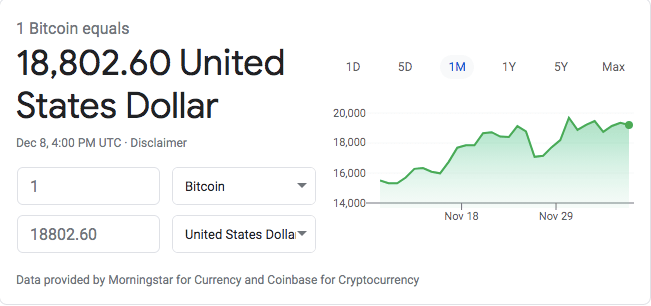
The result of typing “What is the price of bitcoin?” into Google:
What is Ethereum?

If Bitcoin is digital gold, Ethereum is digital plumbing. What??? Sorry, bad metaphor.

The current financial system in the U.S. is woefully outdated. Banks never overhauled their accounting systems to take into account the internet revolution. Instead, they used the internet as a crutch, twisting and copying+pasting their old methods of accounting into digital form. It’s messy and inefficient. The current system is a Rube Goldberg Machine, where you tip a domino over that hits a golf ball that rolls across a wooden slide that somehow makes a bowling ball lever down a staircase that hits some bowling pins that end up pouring cereal into your bowl. It’s crazy confusing.

How long does it take your bank to settle a credit card transaction? Probably 2-3 days. Why? Because the bank has to settle the payment between your credit card company, the place where you made the purchase, the place where you made the purchase’s bank, and your bank. Gross, right.

Ethereum is a protocol, like the internet is a protocol, that allows money to be moved almost instantaneously and very efficiently through something called a “smart contract.” A smart contract is a deceivingly simple concept. It is basically an automated contract that is transcribed to the blockchain (big words that mean written down in a public journal) once the terms of agreement are met by both sides.

In the case of a credit card purchase, the smart contract would look at your bank account and see $4.32, which is enough to purchase a large fry from McDonalds. At the same time, the contract would look for a confirmation that McDonalds does, in fact, have fries and is willing to serve you at the moment. If both sides confirm, the contract is pushed through to the blockchain and automatically transacts.

Ethereum takes out the Rube Goldberg Machine in Finance. If you want a bowl of cereal, you pour the bowl of cereal, instead of having to go through all of that mumbo jumbo with the dominos and the bowling balls.

Pretty cool, right?

That’s all I have for the day

-Kram

12/7/2020

Tweet of the Day:

“Today I learned the dollar has lost 99.93% of its value since 2013 (relative to Bitcoin).” – Edward Snowden… yeah, that Edward Snowden.

An Assortment of BTC Prices:

1 BTC = 32.35 Ethereum

113 Christmas Trees Priced @ $159 = 1 BTC

.5 BTC = 15 shares of Tesla

When did I first hear about Bitcoin?

Shoutout to my Dad for being so wonderfully deficient in the use of technology because without him I would still be one of those Finance guys on Instagram searching up tips on trading Forex. Ew.

A few months ago, Pops (that’s what I call my Dad) came home with a new business plan. He works at a small idea-incubator shop, so this wasn’t out of the blue. The new business plan, however, was wack.

“These guys, they call themselves bitcoin miners, they want to siphon off some of the excess natural gas currently being flared by many an oil company and use it to mine cryptocurrencies,” my Dad explained whilst scratching his head in total confusion. “Do you know what a Bitcoin is?” he asked.

I said no. I remembered reading an article a few years back in Forbes documenting the rise of a young group of Bitcoin millionaires popping up around San Francisco, but that was it. I had no idea what a cryptocurrency was beside the vague notion that it was sketchy and volatile internet money that I was pretty sure was used to buy drugs and swing crazy trades.

My Pops decided he needed to know more about this internet money in order to provide due diligence for this wack business plan that was bouncing around his incubator. He thought the idea of internet money was pretty interesting. My Pops is cool like that: he cannot, under any circumstances, figure out how to change the input on a TV or turn bluetooth on/off to connect to a speaker, but he can somehow see the potential explosion for an internet based form of money.

So Pops asked me to buy him some Bitcoin. He gave me a few hundred dollars and told me to go crazy.

After buying Pops a few hundred dollars worth, then a few thousand, then a full coin worth, I decided it was time to understand what I was buying.

And down the rabbit hole I went.

It started with a few books. Then a couple dozen articles. Added Pomp’s Podcast and What Bitcoin Did to my daily drive home from work.

In a month I was talking about Austrian Economics and the devaluation of the dollar.

My first purchase of BTC was for $100 on Coinbase. I was the proud owner of .02 BTC.

I’ve been stacking ever since.

That’s all I have for today!

-Kram

12/6/2020

Bitcoin Price in U.S. Dollars:

Nineteen thousand one hundred forty two dollars and fifty two cents

Shocking Stat of the Day:

22% of all money in the U.S. was printed in 2020

Crypto News of the Weekend:

  1. Microstrategy put another $50 million dollars of cash into Bitcoin. Over the past three months Microstrategy, led by their enigmatic CEO Michael Saylor, has pioneered the narrative of Bitcoin as a reserve asset (aka store of value). (https://www.benzinga.com/markets/cryptocurrency/20/12/18663624/microstrategy-buys-50-million-worth-of-bitcoin-topping-up-holdings-to-766m)
  2. Head of the OCC has hinted at a positive set of regulations to be announced in the coming weeks (https://news.bitcoin.com/us-banking-regulator-positive-cryptocurrency-regulation/).
  3. India is planning to tax Bitcoin gains. While this may seem bad for bitcoin holders, it is probably good in the long run, as regulation should boost the confidence of investors that BTC will not be banned. (https://www.coindesk.com/india-plans-to-tax-income-from-bitcoin-investments-report).

Thought of the Day:

Cryptocurrency security is the biggest problem in the industry. Hardware wallets are too difficult for non-tech savvy individuals. Exchanges are too big of targets for hackers and cannot be trusted. Many of the hot wallets are confusing. Seed phrases, private keys, and public keys are not intuitive.

We need to do better if we are going to the moon.

Hope y’all have a good weekend,

-Kram